Case file · II·02
The issue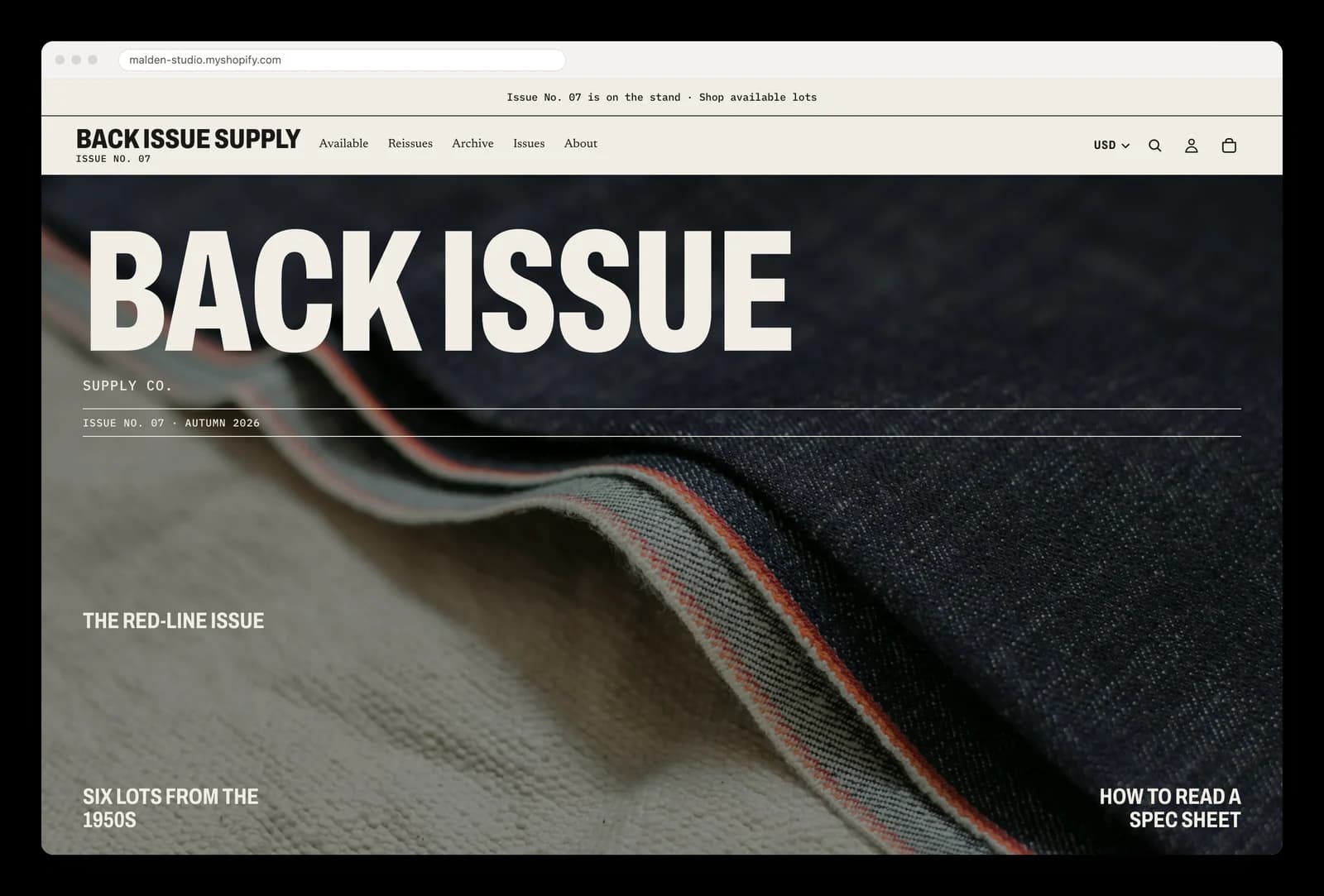
II·02 · Live demo
BACK ISSUE SUPPLY
“A denim archive you read like a magazine.”
- Role
- Designer & Developer, Malden Studios
- Year
- 2026
- Discipline
- Shopify Theme · Concept Build
- Stack
- Shopify · Liquid · JavaScript · Metaobjects · Shopify Flow
Back Issue Supply is a concept brand I built through my studio, Malden Studios: an archive dealer selling one-of-one 1940s–80s denim and workwear to collectors who read product pages like spec sheets. The store is laid out as an issue of a magazine. The home page is the current issue, every garment is a numbered lot with a museum-label spec sheet, and pieces that sell become "back issues" in a permanent, filterable Archive. Alongside the theme I built a five-section pack designed from day one to be sold separately.
System notes
Theme + section pack
A fork of Shopify's Horizon theme with custom masthead, lot cards, Archive and lot templates, plus archive-pack: five clean-room, single-file sections (issue cover, contents, lot hotspots, detail spread, spec sheet) that work in any theme. Horizon's licence doesn't allow redistributing its code, so the sellable sections were written from scratch and synced into the theme by a script.
Data model + automation
Issue, contents and annotation metaobjects plus 13 product metafields, all editable in the admin. A Shopify Flow rule moves a one-of-one to the Archive and stamps its sold date when stock hits zero; Search & Discovery filters by decade, mill and garment type.
Progressive enhancement
Hotspot details are an ordered list in the HTML: without JavaScript you get a readable numbered list, with it you get markers and a sliding drawer. The detail spread's sticky layout is pure CSS, and theme JavaScript totals about 3 KB gzipped.
Measured results
Lighthouse mobile (median of 3): Performance 98–100, CLS 0, SEO 100 across home, lot and Archive pages. A 76-check browser QA suite covers phone and desktop widths, keyboard-only paths, reduced motion and no-JS.
Imagery
A concept store, so no real inventory: the cover and one lot use licensed Unsplash photos, and the other lots and close-ups are AI-generated from one fixed prompt so they read as a single shoot. A client build would swap in real product photography.